The ROI of digital container booking is the net financial benefit a company realises by replacing manual freight booking processes with a digital platform, expressed relative to the cost of operating that platform. For most shippers, the return comes from four measurable sources: faster rate access that enables better buying decisions, reduced demurrage and detention costs through automated monitoring, lower administrative overhead through process automation, and fewer documentation errors that cause costly customs delays. Each of these is quantifiable, and together they typically produce a return that is visible within the first months of use.
How to measure the ROI of digital container booking
Before calculating the return, it is useful to establish the baseline cost of the current process. For most logistics teams operating manually, the relevant cost categories are staff time spent on quote management, carrier communication and status updates; demurrage and detention charges paid in the past twelve months; documentation-related delays and their associated port charges; and any rate premium paid because of limited market visibility at the time of booking.
Each of these categories represents an area where a digital platform produces measurable savings. The calculation does not require precise accounting to be useful. An approximate figure for each category, multiplied across the annual shipment volume, gives a realistic estimate of the addressable cost base.
.jpg)
Where digital platforms generate measurable financial return
Rate optimisation, the value of buying at the right price
Access to real-time rates from multiple carriers at the moment of booking systematically improves rate outcomes compared to periodic manual quote rounds. On lanes where rates fluctuate by 15 to 30 percent within a single month, the ability to book during a favourable window rather than when the quote happens to arrive produces a measurable saving per shipment.
Across an annual shipment programme of even moderate volume, for example 200 to 500 TEU per year, this rate optimisation effect compounds significantly. A consistent 5 percent improvement in average rate paid across that volume represents a material saving relative to the cost of operating the platform.
Furthermore, all-in rate visibility prevents the selection of options that appear competitive on the base rate but are more expensive on a total cost basis once surcharges are applied. This is a systematic improvement in procurement quality that is difficult to achieve through manual processes because the comparison requires simultaneous visibility into multiple carriers' surcharge structures.
Demurrage and detention, the most directly calculable saving
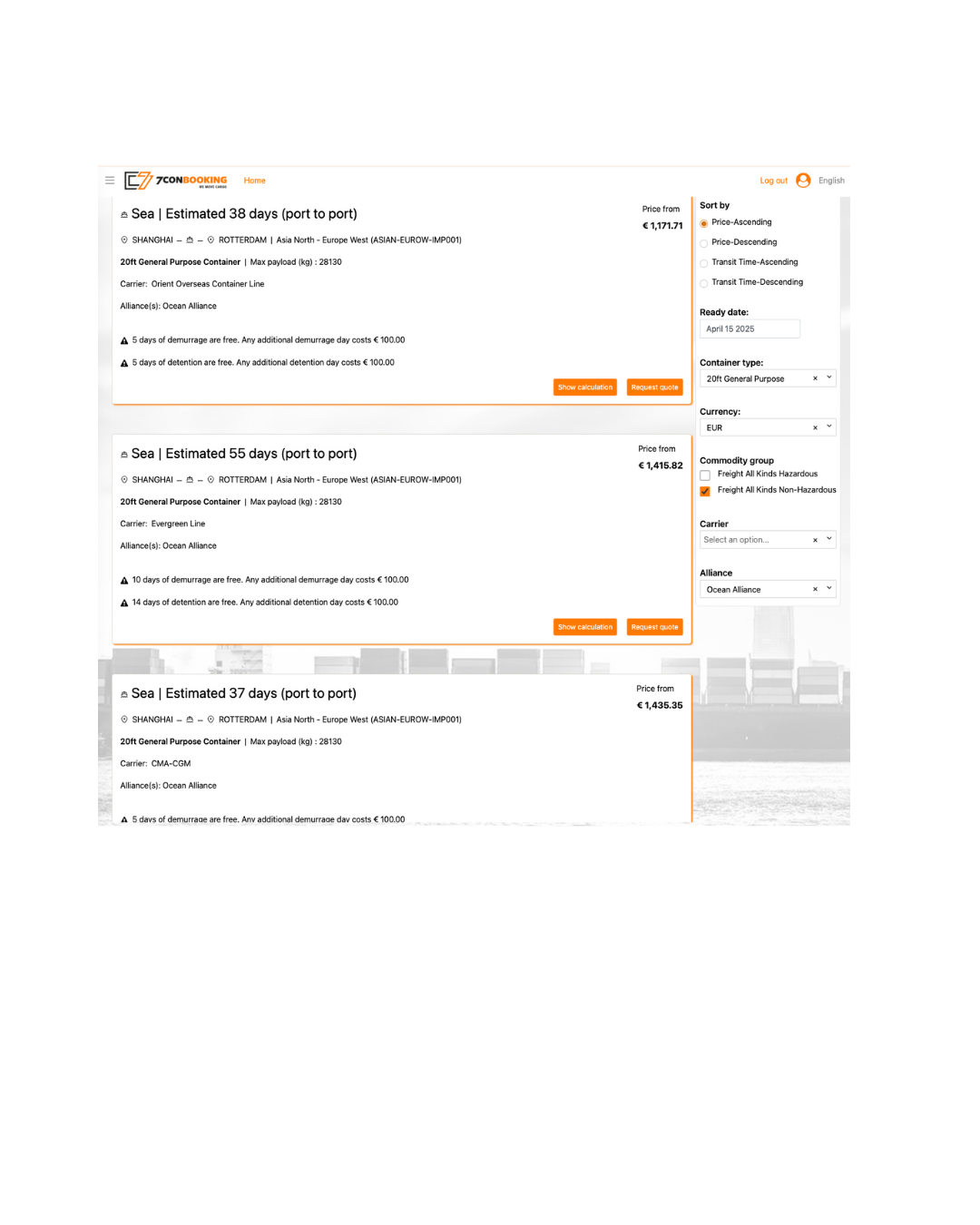
Demurrage and detention are the area where the financial return of digital container booking is most straightforwardly calculable. The inputs are the number of demurrage and detention events in the previous twelve months, the average cost per event and the estimated reduction in events from automated monitoring.
For logistics operations where demurrage and detention events occur regularly, the saving from automated free time monitoring is frequently the single largest line item in the ROI calculation. At rates of 75 to 200 USD per container per day, even a modest reduction in the number and duration of overstays produces a saving that is significant relative to any reasonable estimate of platform cost.
Additionally, avoiding demurrage avoids the downstream disruption associated with delayed container release. When a container is held at port beyond its free time, the receiving warehouse, production schedule or customer delivery is affected. The indirect cost of that disruption, including expedited inland transport, production adjustments and customer relationship impact, is real even when it does not appear directly on a freight invoice.
Administrative time, a cost that is often underestimated
The administrative time that manual freight management consumes is frequently underestimated in ROI calculations because it is embedded in the workday of logistics staff rather than appearing as a separate line item. However, the time a logistics coordinator spends requesting quotes, chasing carrier updates, manually tracking free time and updating internal stakeholders is time that has a cost equal to the hourly rate of that person multiplied by the hours consumed.
For a logistics team spending an average of two hours per day on these tasks, the annual cost of that administrative overhead across a team of two or three people is substantial. A digital platform that automates these tasks does not eliminate the role of logistics staff. However, it redirects that capacity toward higher-value work, which produces a return either as direct cost saving if headcount is reduced, or as productive capacity gain if the team uses the freed time to manage more volume or more complex activities.
How 7ConBooking delivers measurable ROI
7ConBooking delivers the return categories described above through a platform that requires no complex implementation. Real-time rates from multiple carriers provide the rate optimisation benefit from the first booking. Automated demurrage and detention monitoring provides the avoidance benefit from the moment shipments are active in the system. Centralised booking and tracking reduces the administrative time spent on manual status management. And standardised documentation workflows reduce the frequency of compliance-related delays.
Those who want to assess the potential return for their specific operation can start with a free account at app.7conbooking.com and compare the platform's all-in rates against their current freight cost baseline immediately.
Frequently asked questions about the ROI of digital container booking
What is the ROI of digital container booking?
The ROI of digital container booking is the net financial benefit a company realises by replacing manual freight booking processes with a digital platform. The return comes primarily from rate optimisation through real-time market access, demurrage and detention avoidance, reduced administrative overhead and fewer documentation errors causing customs delays.
How do I calculate the baseline cost of my current manual process?
The relevant cost categories are staff time spent on quote management, carrier communication and status updates; demurrage and detention charges paid in the past twelve months; documentation-related delay costs; and any rate premium paid because of limited market visibility. Estimating each category and multiplying across annual shipment volume gives a realistic picture of addressable cost.
How does real-time rate access improve procurement ROI?
Real-time rate access allows shippers to book during favourable market windows rather than at the moment a manually requested quote happens to arrive. On lanes with significant monthly rate volatility, a consistent improvement in average rate paid across annual shipment volume produces a material financial return relative to the cost of the platform.
What is the typical financial impact of demurrage and detention on freight ROI?
At rates of 75 to 200 USD per container per day, demurrage and detention events represent one of the most directly calculable cost categories in freight operations. Automated monitoring that reduces the frequency or duration of overstays produces a saving that is frequently the single largest line item in an ROI calculation for digital container booking.
How is administrative time savings included in the ROI calculation?
Administrative time has a cost equal to the hourly rate of the staff member multiplied by the hours consumed. For teams spending two or more hours per day on manual freight tasks, the annual cost of that overhead is significant. A digital platform that automates those tasks redirects that capacity toward higher-value work, producing a return as either cost saving or productive capacity gain.
How quickly can ROI from digital container booking be realised?
For most logistics operations, measurable return begins from the first bookings made through a digital platform. Rate optimisation and demurrage avoidance produce savings on individual shipments rather than requiring a lengthy accumulation period. Administrative time savings are also realised immediately as manual tasks are replaced by automated processes.
How does 7ConBooking deliver ROI for its users?
7ConBooking delivers ROI through real-time all-in rate comparison that improves procurement outcomes, automated demurrage and detention monitoring that reduces avoidable charges, centralised tracking that reduces administrative time and standardised documentation workflows that reduce compliance-related delays. All of these are accessible from a free account at app.7conbooking.com.
Subscribe to our newsletter
Join our vibrant community to get valuable insights, trends, and industry news delivered straight to your inbox.